
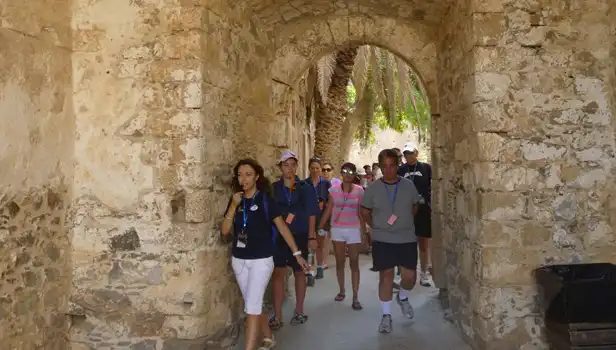
Why Hire a Licensed Guide in Greece
You are standing at the entrance to the Acropolis. Your guide — the person you arranged through a hotel concierge, a travel platform, or an operator whose website advertised “private tours of Athens” — explains that he will be waiting for you at the gate when you come out. He can take you to the site, he says. He cannot go inside with you.
This is not a logistical inconvenience. It is the visible consequence of a legal distinction that Greek law has maintained, in various forms, since 1976 and that was most recently codified in Presidential Decree 38/2010. In Greece, guiding is a licensed profession with its own training, its own state examination, and its own conditions of practice — and there are many people who attempt to do the work without holding the license.
Understanding the distinction before you book is the single most important step in planning a private tour of Greece.
What Greek Law Says
The Greek state licenses tour guides through the Ministry of Tourism.
The license, once granted, authorizes the holder to guide private and group tours throughout Greece: mainland and islands, archaeological sites, museums, and town quarters — inside and outside archaeological zones. Licensed tourist guides are the only accredited professionals who may conduct walking tours in towns, or provide commentary aboard a tour bus or a private touring vehicle as you travel through Greece. The license is issued for life and carries the holder’s photograph, license number, and the languages in which they are authorized to guide.
Unlicensed guiding, inside or outside an archaeological site or museum — whether by a driver, a local with informal knowledge, a foreign guide without Greek accreditation, or an academically well-educated person who has never been licensed — is a violation of Greek law. The fines apply both to the person guiding and to the tour operator who arranged the service.
What the Difference Looks Like in Practice
The distinction is abstract until you arrive at a site. And although guiding outside sites and museums is equally closed to unlicensed individuals, it is at the entrance that the rule becomes concrete very quickly. Some examples:
At the Acropolis: The entrance is controlled. Guides must present their Ministry of Tourism license to accompany a group inside the archaeological area. An unlicensed “guide” — however knowledgeable, however experienced — cannot legally cross the entrance with you. You enter alone or with the licensed guide you have booked. If you have not booked a licensed guide, you receive the site without interpretation.
At the National Archaeological Museum: The museum allows licensed guides to accompany groups through the galleries, providing commentary beside the specific objects. An unlicensed companion — even one with genuine knowledge of the collection — cannot offer this service legally inside the building.
At Delphi, at Olympia, at Epidaurus: The same rules apply across all Greek archaeological sites. The license is the key. Without it, the “guide” waits outside.
And beyond the gates: a walking tour of Plaka, commentary delivered from the vehicle on the road to Delphi, an afternoon through the quarters of Nafplio — all of these are guiding, and all of them require the license. Licensed guides wear it visibly while working. If an inspection takes place while you are on tour and the person guiding you is asked to produce a license, that is routine enforcement rather than anything unusual.
The Questions to Ask Before You Book
When arranging a private tour of Greece — through any platform, operator, or direct booking — these are the questions that establish whether the person guiding you holds the license:
1. Do you hold the Greek tour guide license? A licensed guide can provide the license number immediately. The license is public record.
2. Can you accompany us inside the archaeological site and the museum? A direct question with a direct answer. If the answer involves qualifications (“I know the site very well,” “I can explain everything outside”), it is not a yes.
3. What is the education of a licensed tourist guide in Greece? The license comes from the Tour Guide School, a demanding programme that goes well beyond archaeology. Its curriculum covers the history of every Greek period, art and architecture, the history of theatre, music and dance, folklore, philosophy, botany, economics, tourism psychology and voice training — alongside roughly one hundred days of study visits to cities, museums, archaeological sites and islands. A guide who has completed it has been trained to interpret the whole country, not a single period of it.
4. What languages are you licensed to guide in? This is not separate from the license question but an integral part of it. A tourist guide’s license records the languages in which the holder has been accredited to guide. Under Greek law, certification in each language requires examinations, separate language education, and full supporting documentation submitted to the Ministry of Tourism. A guide may speak ten languages; only those printed on the license may legally be used to guide.
A guide who holds the license will answer all four questions directly.
Frequently Asked Questions
Is it legal to enter Greek archaeological sites without a licensed guide?
Yes — individual visitors can enter archaeological sites independently. The licensing requirement applies to professional guiding: a person who is paid to accompany and interpret a site for visitors must hold the Ministry of Tourism license to do so legally inside the site’s boundaries. You can visit the Acropolis without a guide. You cannot pay someone without a license to guide you inside it.
Is it legal to guide outside archaeological sites and museums without a tourist guide’s license?
This is a frequent misunderstanding. A guided visit with commentary about Greece is provided legally only by certified guides. They are licensed to guide throughout Greece, inside and outside sites and museums. A “guide” who is not wearing their license may be stopped by the authorities and required to produce it.
How many licensed tour guides are there in Greece?
The Greek Ministry of Tourism maintains the official register of licensed guides. The total number across the country is several thousand, covering all regions and multiple languages.
Can I verify a guide’s license before booking?
Yes. The Greek tour guide license number can be cross-referenced with the Ministry of Tourism register. A legitimate licensed guide will have no hesitation in providing their license number and supporting you in verifying it. If a guide declines to provide this information or becomes evasive when asked, that is the answer.
Does a licensed guide cost more than a driver-“guide” or others who practice guiding illegally?
Generally yes — licensed guides command higher fees, reflecting the years of training, the state examination process, and the depth of service they provide. Most travelers who have experienced both regard the licensed guide as the more economical choice.
Elena Gaitani holds the Greek tour guide license. She guides private and group tours — small groups, couples, families and friends, and larger groups on request, such as school and college groups. Every tour is run exclusively for your family or your own group.
If you would like to discuss a specific site, a specific itinerary, or simply which tour is right for your time in Greece, the contact form below reaches her directly.