

Ancient Olympia Private Tour from Athens

For eleven centuries, every four years, the Greek world stopped fighting.
Wars were suspended. Armies stood down. Safe passage was guaranteed across hostile territory for anyone travelling to a single valley in the western Peloponnese, where the Alpheios and Kladeos rivers meet beneath a pine-covered hill. The Olympic truce — the ekecheiria — held for longer than most modern nations have existed. It is arguably the most successful peace agreement in recorded history, and it existed to protect a religious festival that happened to include a footrace.
That valley is Ancient Olympia. It is still there, still green, still quiet.
And it is one of the hardest major sites in Greece to understand on your own — because unlike the Acropolis, Olympia does not announce itself. There is no single monument dominating the skyline. There is a park full of foundations, and the meaning is almost entirely invisible without someone to put it back.
Elena Gaitani is a licensed guide. She puts it back.
Why Olympia Disappoints People — And Why It Should Not
Here is the honest problem with Ancient Olympia, and no one selling tours will tell you this: it is the most under-appreciated great site in Greece, and the reason is architectural.
At the Acropolis, the Parthenon stands. At Delphi, six columns of the Temple of Apollo still rise from the terrace and the mountain does half the work. At Olympia, the Temple of Zeus — which housed one of the Seven Wonders of the Ancient World — lies on the ground exactly where an earthquake left it. The column drums are stacked like fallen coins in the grass. They are extraordinary if you know what you are looking at. They are a pile of rocks if you do not.
This is why visitors arrive at Olympia after a three-hour drive, walk through a pleasant green park for forty minutes, photograph a stone archway, and leave with the quiet suspicion that they have missed something.
They have. They have missed the workshop where Phidias built a statue of Zeus so overwhelming that ancient writers said a man who died without seeing it had lived incompletely — a building that has been positively identified, that you can stand inside, and that most visitors walk past without a glance. They have missed the fact that the starting line they stepped over in the stadium is the original stone, in its original position, and that they have just physically stood where the first Olympic sprinters set their feet.
Olympia rewards knowledge more steeply than any site in Greece. Without it, the site is a garden. With it, it is one of the most affecting places in the ancient world.
Elena Gaitani — Reading Olympia as a Licensed Guide
Elena is a licensed tour guide issued by the Greek Ministry of Tourism — the credential that legally authorises her to lead visitors inside the archaeological site of Olympia and the Archaeological Museum.
This is not a formality, and it is worth understanding before you book anything in Greece. Greek law is unusually strict here: only a state-licensed guide may conduct a tour inside a public archaeological site or museum. A tour manager, or a well-read enthusiast may not. They wait outside the gate. If you have booked a “tour” of Olympia with someone who is not licensed, you will be walking the site alone with a printed map, and you will not find that out until you arrive.
Elena has guided Olympia across many seasons, for visitors ranging from people who have never encountered a Greek site before to those who want a genuinely scholarly conversation. She calibrates to the people in front of her, not to a script.


What You Will Experience at Ancient Olympia
The site of Olympia is unlike any other in Greece to walk through. It is not a rock or an acropolis. It is a valley — lush, shaded, unusually green for the Peloponnese, with the sound of water and the smell of pine. History unfolds inside a landscape here rather than on top of one, and the atmosphere is closer to a park than a ruin field. Elena builds the visit around that quality rather than fighting it.
The Training Grounds — the Gymnasium and the Palaestra
You begin where the athletes began. The gymnasium and the palaestra are where competitors trained for the month of mandatory preparation that preceded the Games — a residency requirement, enforced, that every athlete had to complete on site before he was permitted to compete. Elena explains what that month actually involved, who was allowed to enter, who was excluded and why, and what the athletes were competing for. The answer to the last question is not money, and it is not a medal, and it is more interesting than either.
The Ancient Stadium
Through the vaulted entrance tunnel — the same passage the athletes used — into the stadium itself. The stone starting line is in place. The embankments that held forty thousand spectators are intact. There were no seats; people sat on the grass slopes. Elena describes what the space sounded like, who was permitted to watch, and the single event that mattered more than all the others.
The Temple of Zeus and the Altis
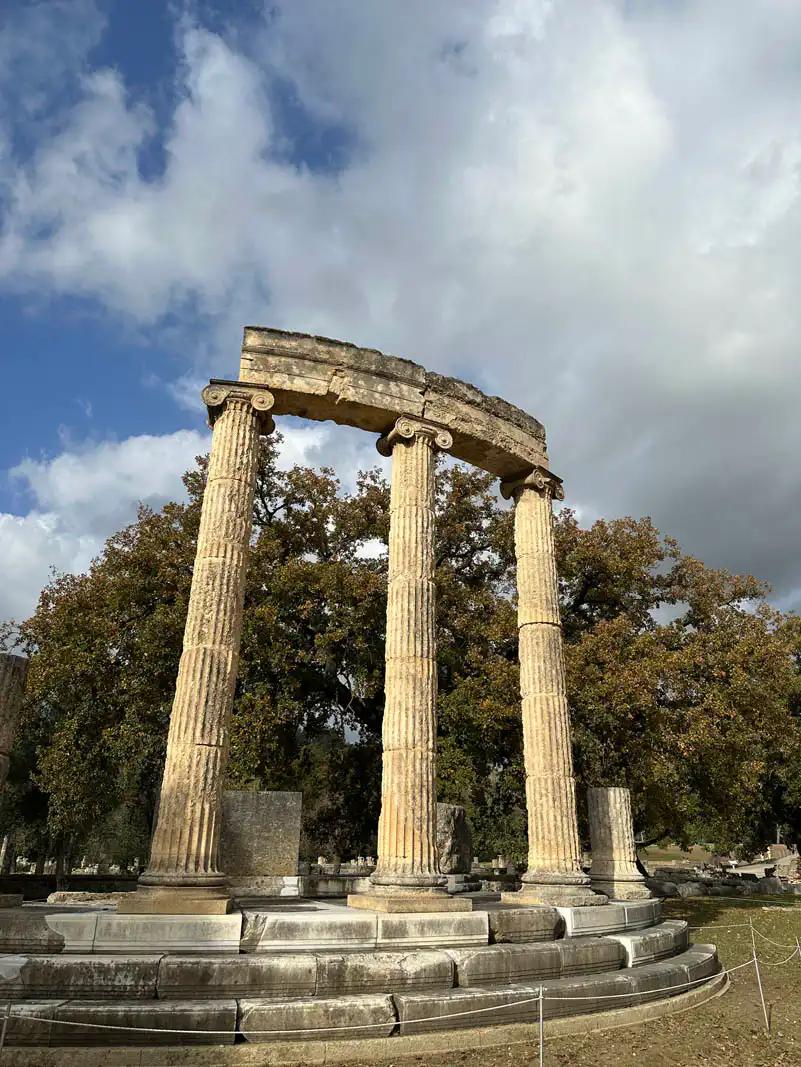
The sacred precinct — the Altis — and the great temple at its centre, now a spectacular field of fallen columns. Elena reconstructs the building in the air above its own foundations: the scale, the sculptural programme, the position of the statue inside it, and the sightline the ancient visitor had walking in. The neighbouring Temple of Hera, older and better preserved, is where the Olympic Flame is still kindled today.
The Workshop of Phidias
One of the most remarkable identifications in Greek archaeology. The building where Phidias assembled the forty-foot chryselephantine statue of Zeus — gold and ivory over a wooden core, one of the Seven Wonders — was located because excavators found the sculptor’s tools, the moulds for the drapery, and a cup with his name scratched on the base. Elena takes you inside and reconstructs the work: how a statue that size was built, how it was lit, and what it did to the people who walked in and saw it for the first time.
The Archaeological Museum of Olympia
One of the finest museum collections in Greece, and the reason Olympia repays a full visit. Elena guides you through the pediments of the Temple of Zeus — reassembled and mounted at eye level, so you can read the sculptural narrative the way almost no ancient visitor ever could — the Nike of Paionios, and the Hermes of Praxiteles, one of the very few works plausibly attributed to a named master sculptor of the Classical period.
The Meaning of the Games
Throughout the visit Elena returns to the question the site actually exists to answer: what the Games were for. The Olympic truce, the idea of a competition that suspended war, and the deliberate continuity between that idea and the modern Torch Relay — which begins here, at the Temple of Hera, and travels from this valley to whichever city is hosting. You will finish at the spot where the flame is lit.
Frequently Asked Questions about Olympia
You can walk Ancient Olympia in forty minutes. Many people do. They cross the stadium, photograph the arch, admire the greenery, and drive back to Athens having stood in the place where the Western idea of athletic competition was invented — without ever being told that is what happened here.
The site will not stop you. It has no signs worth reading and no monument that does the explaining for you. Olympia gives up its meaning only to people who arrive with someone who already knows it.
That is the entire difference between a long drive and one of the best days you will spend in Greece.