
How Many Days Do You Need in Athens?
The question arrives in almost every enquiry: how long is enough for Athens?
The answer travellers usually receive is two days, offered without explanation. It is not wrong. It is simply incomplete, because it treats Athens as a checklist of monuments rather than as a city with three thousand years of continuous occupation stacked one layer on top of another, much of it visible if you know where the layers surface.
What follows is not a list of attractions. It is a description of what each additional day actually adds — what you gain on the second morning that the first could not give you, and what happens on the third day that changes the first two retrospectively.
Athens is not a difficult city to see. It is a difficult city to see well in a hurry.
One Day — the Acropolis and Its Foundation
A single day in Athens is a real day, and it can be an excellent one, provided it is not spent moving between distant points.
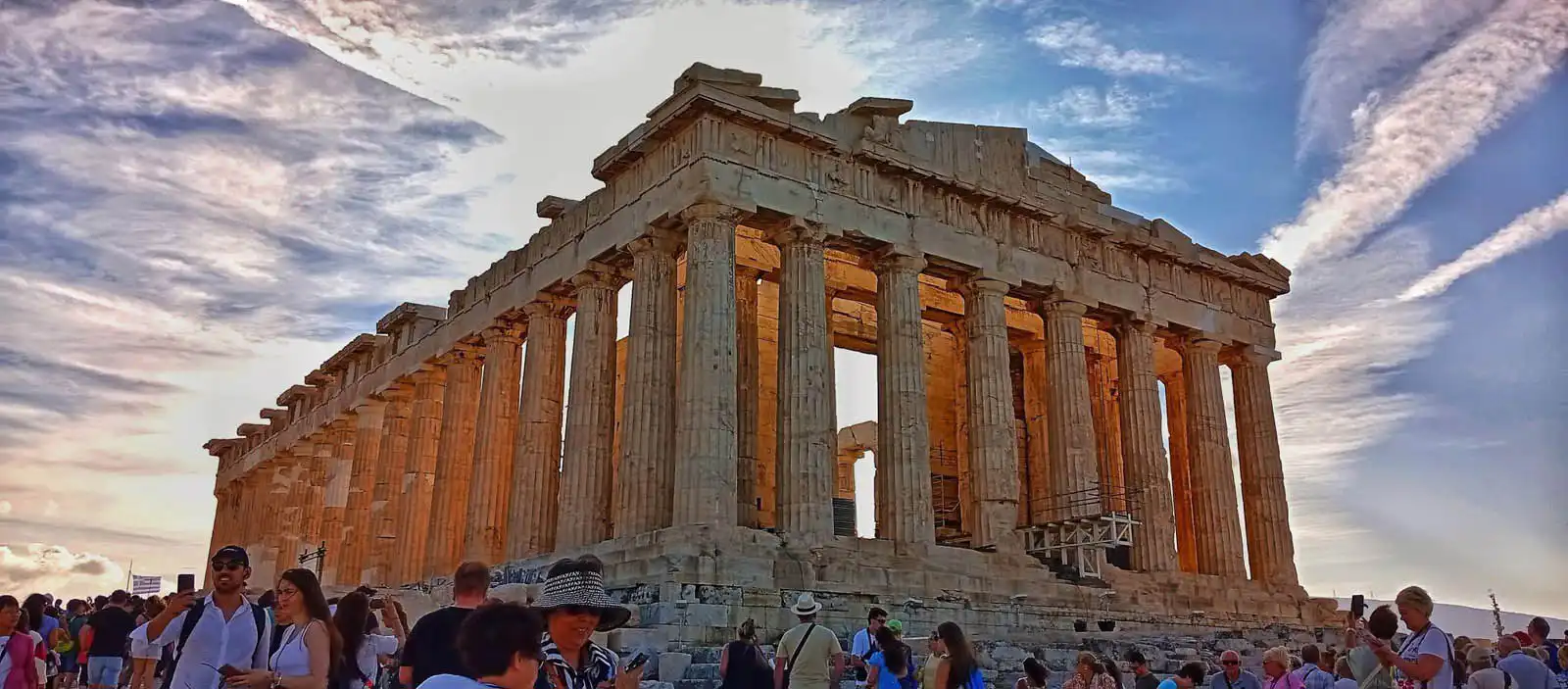
The morning belongs to the Acropolis with all its monuments : the elegant temple of Athena Nike, the imposing monumental gate of the Propylaia that welcomes the visitors of the sacred rock for more than two and a half thousand years, the architecturally unique Erechtheion with the renowned Caryatids porch, and the culmination of it all: the Parthenon, the masterpiece that dominates at the highest point of the sacred rock, crowning the city.
The afternoon belongs to the Acropolis Museum, three hundred metres downhill. This sequence matters. The sculptures that decorated the buildings you have just walked past are inside the museum, arranged on the top floor in the orientation and dimensions of the Parthenon itself, with the gaps where the removed sculptures should be left conspicuously empty. Seeing the buildings first and the sculpture second is the order in which the fifth century BC intended them to be experienced.
If time remains, the Ancient Agora sits below the north slope: the civic square where Socrates argued, where the law courts sat, where the reconstructed Stoa of Attalos now houses the finds. It is a fifteen-minute walk and it completes the day, because the Acropolis was where the Athenians met their gods and the Agora was where they met each other.
One day gives you: the sacred rock, its sculpture, and — with a brisk pace — the civic centre beneath it. It gives you classical Athens. It gives you nothing else, and it is enough to justify the visit.
Two Days — the National Archaeological Museum Changes the Scale
The second day is where most travellers stop, and where the city stops being a single monument.
The National Archaeological Museum is not an Athens museum. It is a museum of Greece, and it is one of the three or four great collections of antiquity anywhere. The gold from the shaft graves of Mycenae, including the funeral mask that Heinrich Schliemann optimistically attributed to Agamemnon. The Antikythera Mechanism — a geared bronze astronomical calculator recovered from a shipwreck, a device of a complexity that nothing else approaches for over a thousand years afterwards. The Artemision Bronze, a god poised to throw, recovered from the sea. Cycladic figurines from the third millennium BC whose abstraction anticipates twentieth-century sculpture by five thousand years.
Three hours there rearranges the previous day. The Acropolis stops being the beginning of Greek history and becomes a late and rather sophisticated episode within it.
The second afternoon then belongs to the layers the first day skipped: the Temple of Olympian Zeus and Hadrian’s Arch, which record Roman Athens; the Kerameikos, the ancient cemetery, quiet and green, where the grave monuments demonstrate what Athenians thought about death; and the Panathenaic Stadium, rebuilt in marble for the first modern Olympics in 1896.
Two days give you: classical Athens and the four thousand years surrounding it. This is the point at which the city becomes coherent.
Three Days — the City Stops Being an Archaeological Site
The third day is the one that most itineraries omit and that most visitors, afterwards, describe as the day they remember.
It has nothing to do with antiquity. It is the day for the neighbourhoods: Anafiotika, the cluster of Cycladic-style houses built into the north slope of the Acropolis by island stonemasons brought to build the royal palace in the 1830s. Plaka below it. Monastiraki and its Sunday flea market. Psyrri, which was a working-class quarter and is now the city’s most alive one after dark. Exarcheia, which is neither.
It is also the day for the museums that require calm: the Benaki, the Museum of Cycladic Art, the Byzantine and Christian Museum — the last of which explains the thousand years of Greek history that classical tourism omits entirely, and without which nothing about modern Greece can be understood.
And it is the day for the view. Lycabettus at the end of the afternoon, or Filopappou Hill, which is lower, quieter, and looks directly at the Acropolis rather than down on it.
Three days give you: a city, rather than a site. Travellers who allocate the third day describe Athens differently afterwards. This is not sentiment. It is what happens when a place stops being a monument and becomes somewhere people live.
Four Days or More — Athens as a Base
Beyond three days, the calculation changes: additional time in Athens is best spent leaving it.
Cape Sounion is seventy kilometres down the coast, roughly an hour and a quarter, and the Temple of Poseidon at the end of the promontory is the finest late-afternoon in Attica. Delphi is two and a half hours northwest and merits a full day. Mycenae and Epidaurus, in the Argolid, can be combined into one — the Bronze Age citadel in the morning, the theatre with the impossible acoustics after lunch. The islands of the Saronic Gulf, Aegina and Hydra above all, are reachable by ferry from Piraeus.
Each of these is a day trip that returns to the same hotel. This is the practical argument for Athens as a base rather than a stopover: within ninety minutes of the city there is Mycenaean, classical, Roman, Byzantine and island Greece, and none of it requires repacking.
The Mistake That Costs the Most Time
The commonest planning error is not allocating too few days. It is allocating enough days and then spending them badly — arriving at the Acropolis at midday in July with the rock at its most crowded and its most exposed, queueing for the museum in the afternoon when the light on the top floor has gone, and crossing the city three times in one day because the itinerary was assembled from a list rather than a map.
Athens rewards sequence. The Acropolis in the first two hours after opening or the last two before closing. The National Archaeological Museum in the middle of the day, when it is cool inside and the streets are not. The neighbourhoods in the evening, when they wake up. The order costs nothing and returns hours.
Frequently Asked Questions
Is two days enough for Athens?
Two days covers the Acropolis, the Acropolis Museum, the Ancient Agora, and the National Archaeological Museum, with time for the Temple of Olympian Zeus and Kerameikos. That is a complete introduction to the ancient city, and most visitors leave satisfied. A third day adds the neighbourhoods, the Byzantine collections, and the sense of Athens as an inhabited place rather than an archaeological zone.
What can you see in Athens in one day?
The Acropolis in the morning and the Acropolis Museum in the afternoon, in that order, with the Ancient Agora added if the pace allows. One day should be spent entirely within walking distance of the sacred rock. Attempting the National Archaeological Museum on the same day means seeing both institutions poorly.
What is the best order to visit the Acropolis and the Acropolis Museum?
The Acropolis first, the museum afterwards. The museum displays the architectural sculpture from the buildings on the rock, arranged in the orientation and proportions of the Parthenon. Visitors who see the sculpture before the buildings lose the connection; those who see it afterwards recognise every fragment.
Is Athens worth more than a stopover on the way to the islands?
Athens is the only city in Europe where four millennia of continuous urban history are visible within a single walkable district. Travellers who treat it as an airport with a temple attached generally return. Three days is the point at which the city justifies itself independently of the islands.
Do I need a guide for the Acropolis?
Greek law reserves guiding inside archaeological sites and state museums to guides licensed by the Ministry of Tourism, and the Acropolis rewards one considerably. The rock is not signposted in any depth, the Erechtheion is unintelligible without its history, and the relationship between the buildings above and the sculpture below is the entire point of the visit. A licensed private guide may accompany visitors inside both the site and the museum.
Most visitors to Athens arrive with the number of days already decided by flights, ferries and cruise schedules. The question that remains is what those days hold.
Elena Gaitani is a licensed private guide, authorized by the Greek Ministry of Tourism. She builds Athens itineraries around the time travellers actually have — one day, two, or a week using the city as a base — and she guides them inside the sites where a licence is required.