
Athens to Delphi: The Complete Day Trip Guide
Delphi sits one hundred and eighty kilometres northwest of Athens, on the southern slope of Mount Parnassus, at an altitude of roughly five hundred and seventy metres. The drive takes at least three hours in ordinary traffic. This makes it one of the few genuinely rewarding day trips from Athens: far enough to feel like a departure from the city, close enough that the return journey does not consume the evening.
The ancient Greeks called this place the navel of the world. They meant it literally. For nearly a thousand years, kings, generals, colonists and ordinary citizens travelled here to ask a question of Apollo before making a decision that could not be undone.
The modern visitor arrives with a camera and ninety minutes. What follows is how to spend the day so that Delphi becomes something more than a photograph of columns against a mountain.
The Route — and Why It Matters
The road from Athens runs northwest through the Boeotian plain, passing Thebes and Livadeia before it begins to climb. Somewhere after Livadeia the landscape changes character entirely. The agricultural flatland gives way to the limestone mass of Parnassus, and the road starts to wind upward through olive terraces toward Arachova, a stone village clinging to the mountainside at around nine hundred and fifty metres.
Arachova is eleven kilometres before Delphi. Most itineraries treat it as a coffee stop. It deserves rather more: it is the point at which you understand, physically, why the sanctuary was placed where it was. Delphi is not on a mountain. Delphi is on a ledge — a narrow shelf of workable ground between the sheer cliffs known as the Phaidriades and a ravine that drops toward a sea of olive trees stretching to the Gulf of Corinth.
The ancients chose this ledge because it was hard to reach and impossible to forget. The approach was part of the experience. It still is, which is why the journey rewards an early departure. Leaving Athens before eight in the morning means arriving at the site while the light is still coming over the ridge and the cliffs are lit from the side rather than from above.
What the Sanctuary Actually Contains
Visitors frequently describe Delphi as “the ruins of the oracle.” The description undersells what survives. The sanctuary of Apollo is a complete religious complex, ascending a steep slope in a series of terraces, and each terrace was built for a reason.
The Sacred Way begins at the lower entrance and switchbacks upward. It was lined, in antiquity, with monuments and treasuries — small temple-like buildings erected by individual Greek cities to house their offerings to the god. These were not modest gestures. They were architectural arguments. A city that had won a battle built a treasury at Delphi, filled it with captured armour, and inscribed the story on its wall where every rival delegation would read it on the way up. The Athenian Treasury, which stands reconstructed today, was built in the early fifth century BC and was associated in antiquity with the victory at Marathon.
The Temple of Apollo occupies the central terrace. The foundations and six re-erected columns belong to the fourth-century BC building — the third temple on the site. The two earlier ones were destroyed by fire and earthquake respectively. Ancient sources record that the maxims Know thyself and Nothing in excess were inscribed at the entrance. Somewhere within the interior chamber, the priestess known as the Pythia delivered the responses that made this sanctuary the most consulted institution in the Greek world.
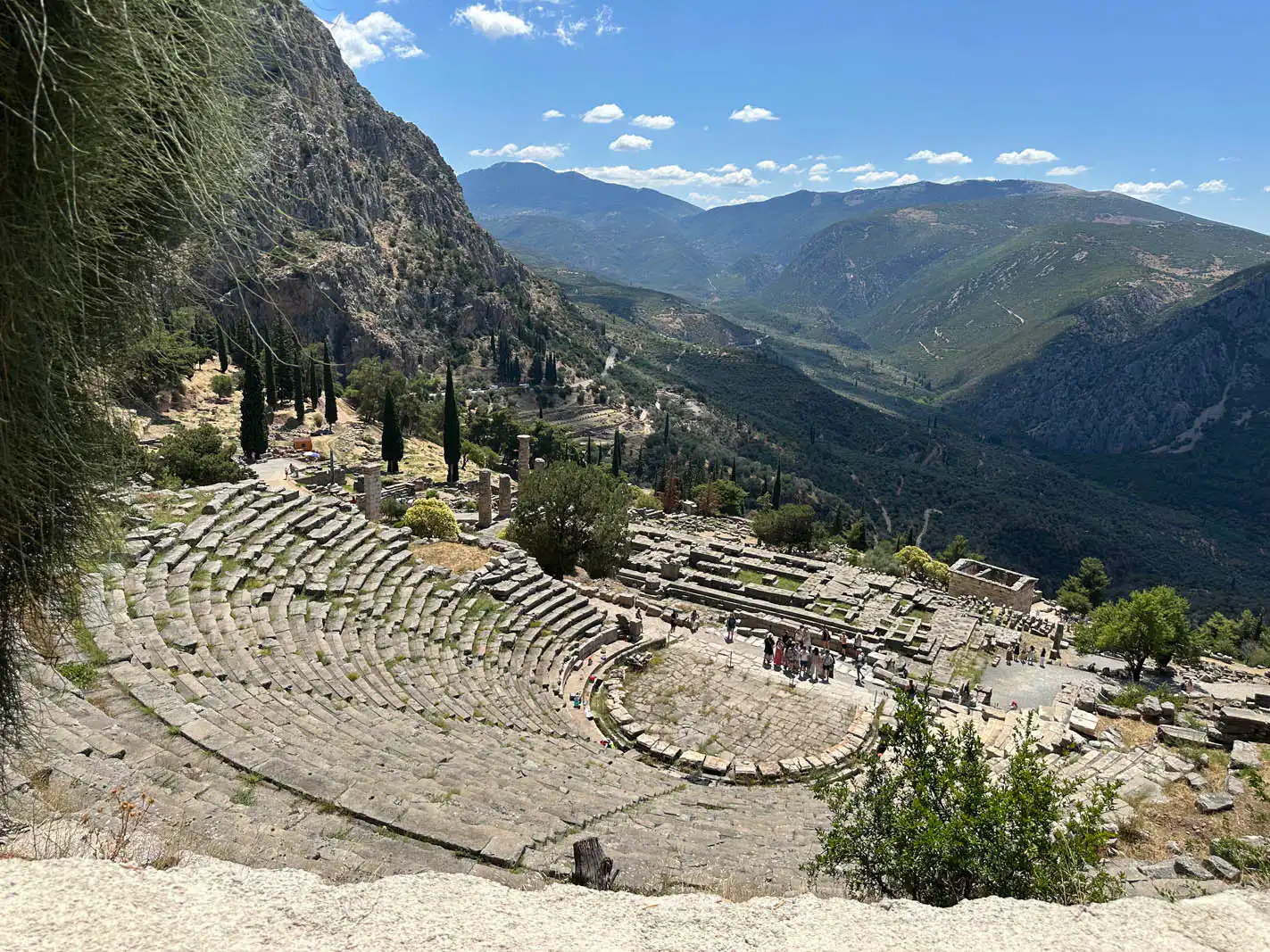
The Theatre, above the temple, seats around five thousand and offers the view that appears on most photographs of Delphi — the temple below, the ravine beyond, the olive plain and the distant water.
The Stadium, at the very top of the site, is the best-preserved ancient stadium in Greece. It hosted the Pythian Games, held every four years, second in prestige only to Olympia. The stone starting blocks remain, with grooves cut for the runners’ toes.
Below the main sanctuary, across the modern road, stands the enclosure of Athena Pronaia — and within it the Tholos, a circular building of the early fourth century BC whose three re-erected columns have become the emblem of Delphi. It photographs beautifully. It is also, structurally, one of the more mysterious buildings to survive from antiquity: nobody knows with certainty what it was for.
The Museum Is Not Optional
The Delphi Archaeological Museum stands beside the site, and the two are halves of a single object. Everything portable that the sanctuary contained is inside.
The Charioteer of Delphi alone justifies the visit. Cast in bronze around 470 BC, dedicated by a Sicilian ruler after a victory in the chariot race, he survived because an earthquake buried him. Almost every other large Greek bronze was melted down in later centuries for the value of the metal. What stands in that room is not a Roman marble copy of a lost Greek work — the condition in which most “Greek sculpture” reaches us — but the original object, with eyelashes of bronze and eyes of enamel and stone, made by a workshop whose name we do not know.
The museum also holds the archaic Sphinx of the Naxians, the frieze of the Siphnian Treasury — a sculpted account of gods and giants at war, carved before 525 BC — and the twin kouroi traditionally identified as Kleobis and Biton, whose story Herodotus tells in the first book of his Histories as an answer to the question of who is the happiest of men.
A visit that skips the museum sees the architecture of Delphi and misses its content.
Delphi in a Day — a Realistic Shape
The arithmetic is straightforward. Three hours of driving. The site and museum together reward two to three hours of unhurried attention. The day works comfortably, and it works badly if any part of it is rushed.
The order that produces the best day: arrive at the site first, walk the sanctuary from the lower entrance to the stadium while the morning is cool and the terraces are quiet, then descend to the museum, where the objects you have just seen the settings for acquire their meaning.
One practical note that changes the day: the sanctuary is a hillside, not a flat archaeological park. The path from the entrance to the stadium climbs roughly one hundred and fifty metres of elevation on uneven ancient paving. Sensible shoes are not a nicety here. They are the difference between reaching the stadium and deciding, halfway up, that the theatre is far enough.
Delphi or Meteora — the Question Everyone Asks
Travellers planning a first visit to Greece often try to combine Delphi and Meteora into a single day. The distance makes this unwise. Meteora lies roughly three hours beyond Delphi, in Thessaly. Attempting both in one day from Athens produces around ten hours in a vehicle and perhaps two hours of monasteries and monuments.
The two sites also answer different questions. Delphi is classical Greece: the sanctuary at the centre of a religious and political world, the place where a city-state went to ask whether to found a colony or fight a war. Meteora is Byzantine and monastic — sixth-century hermits, fourteenth-century monasteries on sandstone pillars, a different Greece entirely, separated from Delphi by more than a millennium.
Given one day, choose Delphi. It is closer, it is classical, and it connects directly to everything seen at the Acropolis. Given two, do both properly, with a night in Kalambaka or Arachova between them.
Frequently Asked Questions
How long is the drive from Athens to Delphi?
Approximately one hundred and eighty kilometres, or at least three hours by car in normal conditions, via the national road through Thebes and Livadeia and then up through Arachova. Public buses run from the Liosion terminal in Athens and take closer to three hours, with limited daily departures that constrain how long you can spend at the site.
Is Delphi worth visiting as a day trip from Athens?
Yes, provided the day is built around the site rather than the drive. Delphi is one of the two or three most significant sanctuaries of the ancient Mediterranean, the archaeological museum contains original Greek bronze sculpture of the first rank, and the setting on the slope of Parnassus is among the most dramatic in Greece. A day trip that allows three to four hours on site and includes the museum is genuinely worthwhile.
What is the best time of day to visit Delphi?
Early morning. The site opens in the morning and the first two hours are the coolest, the quietest, and the best lit — the sun comes over the ridge from the east and rakes across the terraces rather than flattening them from overhead. Coach groups typically arrive in the middle of the day. Arriving at opening and finishing at the museum around midday inverts the pattern.
Can Delphi be combined with Meteora in one day?
It can be attempted and it is rarely satisfying. Meteora is roughly three hours beyond Delphi, and a single day encompassing both from Athens means close to ten hours of driving. Travellers who want both are better served by an overnight stop, which turns a punishing day into two comfortable ones.
Do I need a guide at Delphi?
The site is not self-explanatory. The treasuries along the Sacred Way, the successive temples, the relationship between the sanctuary and the museum’s contents, and the mechanics of the oracle itself are all invisible to an unaccompanied visitor reading a signboard. A licensed guide, authorized by the Greek Ministry of Tourism, may accompany visitors inside the archaeological site and museum and explain what the stones record. Without one, Delphi is a beautiful hillside with excellent views.
Delphi rewarded people who arrived with a question. It still does. The difference between a visit that produces photographs and one that produces understanding is whether anyone on the day can read the site — the inscriptions on the treasury walls, the sequence of the temples, the political argument encoded in a marble frieze.
Elena Gaitani is a licensed private guide, authorized by the Greek Ministry of Tourism. She guides Delphi as a day trip from Athens for travellers who would rather understand the sanctuary than photograph it.