
Private Acropolis Tour in Athens — With a Licensed Guide
Discover Acropolis
You have been looking at photographs of the Parthenon for most of your life. In school textbooks, in museum prints, in the background of a thousand travel images. You know the silhouette — the columns, the hill, the sky above it.
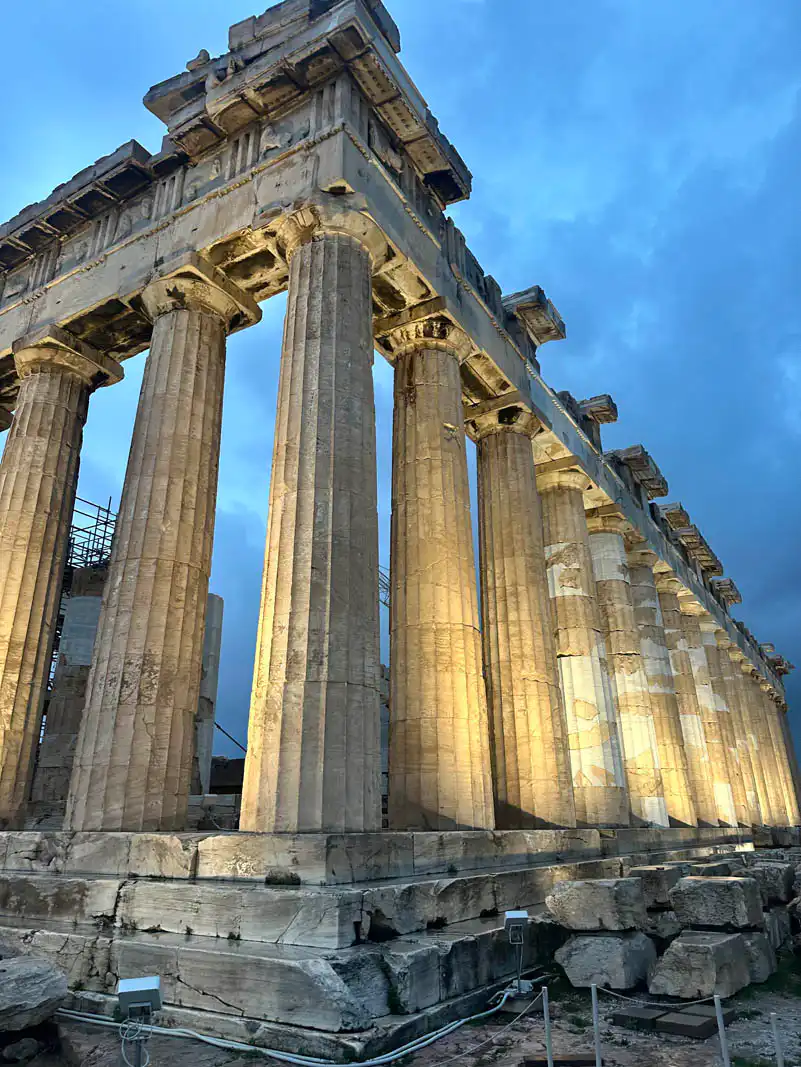
What the photographs do not show is this: the Parthenon contains no straight lines. Not a single one. Every horizontal surface curves upward slightly at the centre. Every column leans inward by a fraction of a degree. Every column’s shaft swells gently at one third of its height. These deviations from geometric perfection were deliberate, calculated by craftsmen who understood perception well enough to correct for it — producing a building that reads as perfectly straight and vertical from every approach angle, despite being none of those things.
This is one of the first things Elena Gaitani tells you when you stand in front of it. By the time she finishes, the most photographed building in the world has become something you have never quite seen before.
What Most Acropolis Visits Actually Look Like
The Acropolis receives approximately three million visitors per year. On a summer morning, the queue at the main entrance can stretch back two hours. On a busy afternoon, the plateau around the Parthenon contains several thousand people simultaneously — enough to make it difficult to stand still, to look, to think.
Most visitors navigate this with an audio guide: a device that delivers pre-recorded commentary triggered by GPS location, calibrated for the average visitor moving at average pace. The information is accurate. It is also the same information everyone around you is receiving, delivered at the same moment, in the same words. It does not respond to your questions. It does not notice what you are looking at. It cannot tell the difference between a person who has studied classical architecture and a person who is seeing a Doric column for the first time.
Then there is the licensing question. Only a certified guide holding the Greek Ministry of Tourism credential may lead visitors through the Acropolis complex as a professional guide. Many of the individuals offering “guided tours” of the Acropolis — through tour operators, through online booking platforms, through the ship’s excursion desk — do not hold this credential. They accompany their clients to the entrance and stop there. What leads you across the plateau is an audio device and your own orientation.
Elena does not stop at the entrance.
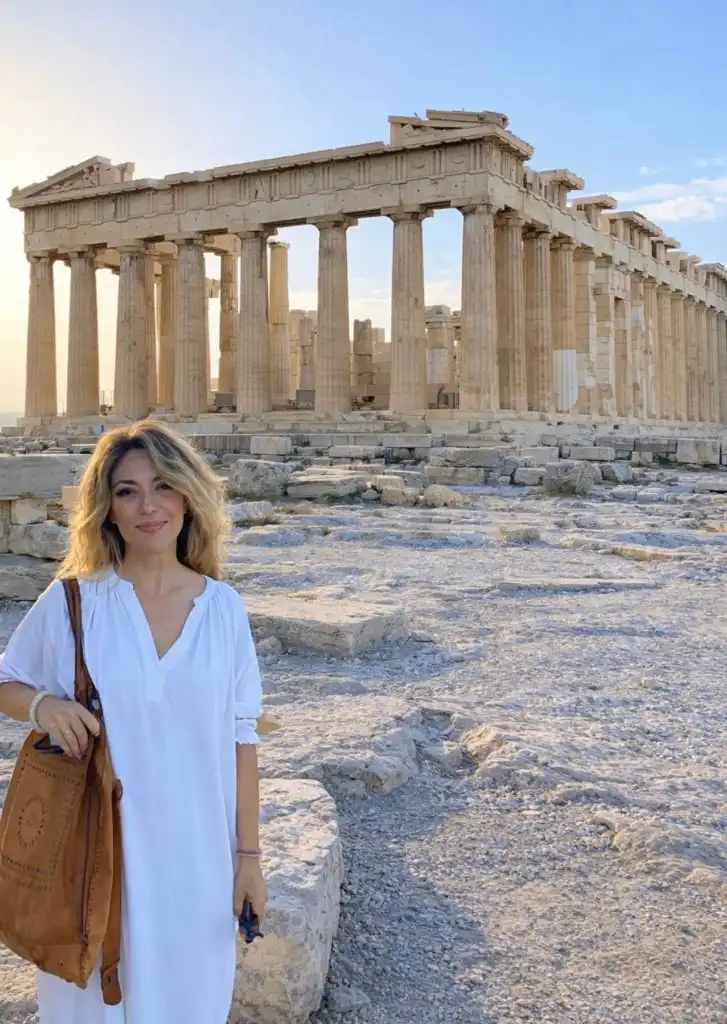
Elena Gaitani — Inside the Parthenon With You
The Acropolis and its architectural program are among Elena’ s core areas of academic expertise — she has guided private tours of the monument across many seasons, for guests ranging from architects and classicists who want peer-level engagement to first-time visitors who simply want to understand what they are looking at.
She enters the Acropolis complex with you. She walks with you through the Propylaea, past the Temple of Athena Nike, across the plateau to the Parthenon and the Erechtheion. She answers your questions in real time, adjusts the depth and pace of the tour to what genuinely interests you, and knows — because she has guided thousands of people through this space — which observations land, which questions open the site up, and which details change the way a person sees the monument for the rest of their life.
The Acropolis is eleven acres. Two hours with Elena is a different experience from two hours with a device.
What You Will Experience — The Monument in Detail
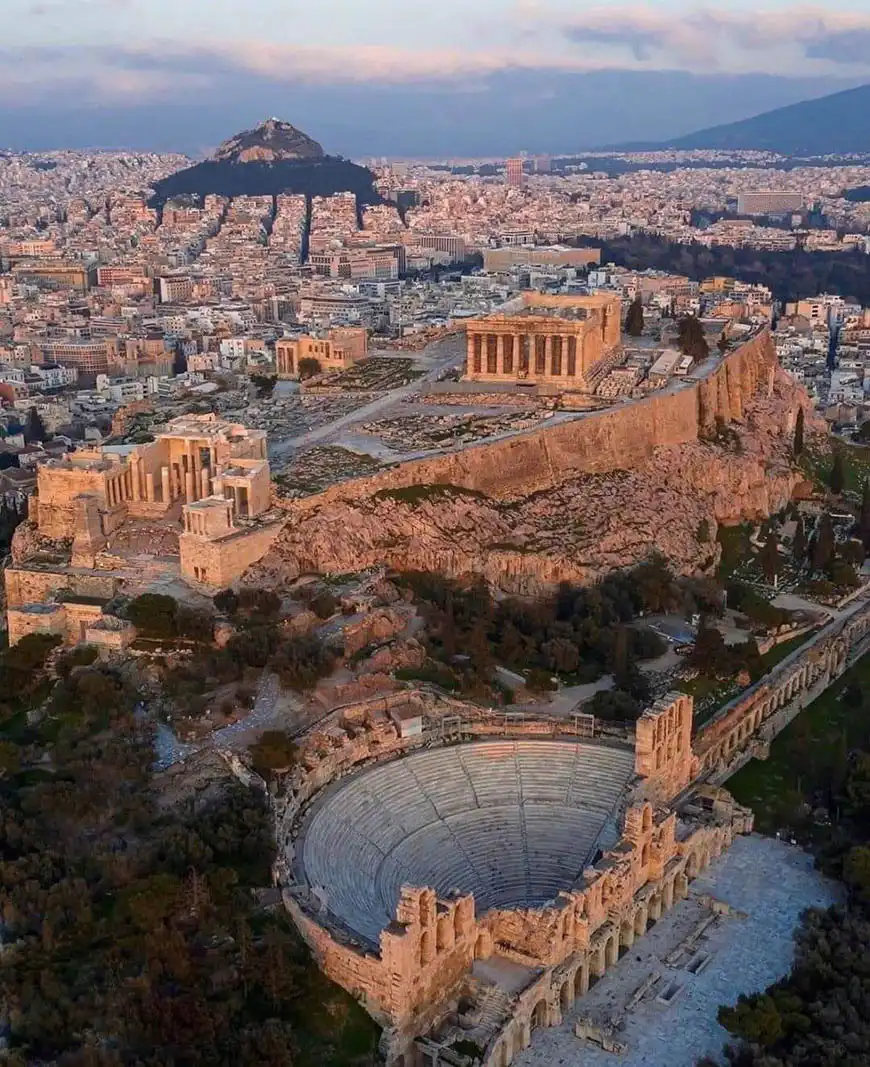
Elena approaches the Acropolis from the west — the ancient processional path, the same route that Athenian citizens walked during the Panathenaic festival, the greatest civic and religious celebration of the ancient city.
The Propylaea — The Gateway That Is Also a Masterpiece
The monumental gateway to the Acropolis is rarely the subject of the photographs — it is the thing you pass through to reach the photographs. This is a mistake. The Propylaea, constructed between 437 and 432 BC by the architect Mnesikles, is an architectural achievement of the first order: a building that negotiates an irregular hillside, incorporates two different column orders in a single structure, and creates the experience of processional ascent through a carefully orchestrated sequence of compression and release.
Elena reads it structurally and experientially — explaining why the ceiling of the central hall was painted dark blue with gold stars (a reconstruction now visible in the museum), why the south wing remains truncated, and what the ancient Athenian would have felt passing through this gateway toward the sacred space above.
The Temple of Athena Nike
On the right-hand bastion as you ascend, the small Ionic temple of Athena Nike — goddess of victory — commands a view of the Saronic Gulf and, on clear days, of the island of Aegina. Elena explains the temple’s specific function: a propitiation of the victory goddess at the moment of entering a sacred precinct, the political significance of the frieze depicting Athenian victories over Persia, and the extraordinary fact that the temple was dismantled by the Ottomans in the seventeenth century to build a cannon platform, then reconstructed — and has since been dismantled and reconstructed twice more as modern conservation techniques have evolved.
The Parthenon — Reading the Most Studied Building in History
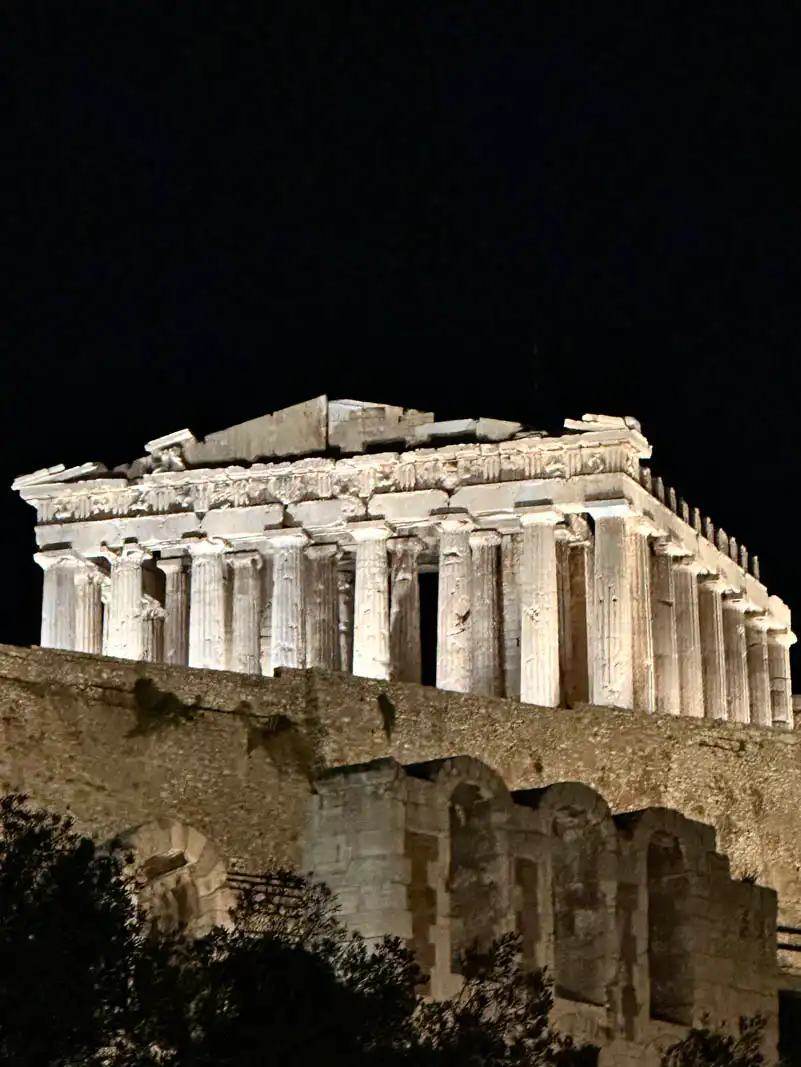
Standing in front of the Parthenon for the first time is an experience with a specific structure. First: the scale, which photographs consistently underrepresent. Then: the damage — the missing roof, the gap where the central explosion of 1687 blew out the interior. Then, if you have the right companion: the details that restore the building.
Elena walks you through the optical corrections — the entasis of the columns, the curvature of the stylobate, the slight inward lean of the colonnade — and explains precisely what perceptual problem each one solves. She reconstructs the original polychrome: the triglyphs painted blue, the metopes painted red, the sculptural program of the pediments in vivid colour against a background that read, from the city below, as a continuous painted narrative.
She explains the Parthenon frieze — the continuous band of sculpture running around the exterior of the inner building, depicting the Panathenaic procession in carved marble — and what it meant for a civic building to represent the citizens of Athens in the same visual language previously reserved for gods and heroes. This is not a minor observation. It is one of the most radical artistic decisions in the history of Western art.
The east pediment depicted the birth of Athena. The west depicted her contest with Poseidon for the patronage of the city. The metopes on the south showed the battle between the Lapiths and the Centaurs — a mythological allegory for the Greek victory over Persia. Elena reads each program and connects it to the specific historical moment — 447 to 432 BC, the height of Athenian power and confidence — that produced it.
The Erechtheion and the Caryatid Porch
On the north side of the plateau, the Erechtheion is the Acropolis’s most architecturally complex building — an irregular plan dictated by the multiple sacred obligations it housed: the ancient olive tree of Athena, the mark left by Poseidon’s trident, the tomb of the mythical king Kekrops. Its south porch replaces the usual columns with six draped female figures — the Caryatids — standing as structural members. Five originals remain on the building (protected replicas); the sixth is in the British Museum in London.
Elena explains the iconographic logic of the Caryatids: not decorative, but a theological statement about service, devotion, and the relationship between the human figure and architectural structure. She also explains why one of them is in London — and what the ongoing campaign for their return reveals about the politics of cultural heritage.
The Acropolis Museum — The Second Chapter
At the foot of the hill, the Acropolis Museum — opened in 2009 and designed by the architect Bernard Tschumi — houses the original sculptural program of the Parthenon alongside finds from the Acropolis slopes spanning three thousand years of occupation.
If your schedule allows a second hour, Elena guides you through the museum’s three principal galleries: the Archaic Gallery on the ground floor, with its collection of sixth-century korai and kouroi; the intermediate level with the finds from the Acropolis slopes; and the Parthenon Gallery on the third floor — a glass-enclosed space aligned with the monument above, displaying the surviving frieze blocks alongside cast replicas of the sections now in London, reuniting the narrative for the first time since 1801.
The museum is also, among other things, an argument. Its alignment with the Parthenon, its display of the complete frieze, and its transparent architecture — visible from the monument, the monument visible from within it — make a specific case for the return of the Parthenon Marbles. Elena explains the argument, its history, and its current political status without advocacy, giving you the information to form your own view.
Frequently Asked Questions
You Have Been Looking at This Building Your Entire Life. See It Properly.
The Acropolis will be there regardless of how you visit. The queue will eventually move. The photographs will be taken.
What changes with Elena is what you carry home from it — the understanding, the detail, the moment when a building you thought you knew becomes something genuinely new.