
Private Tour of Delphi from Athens
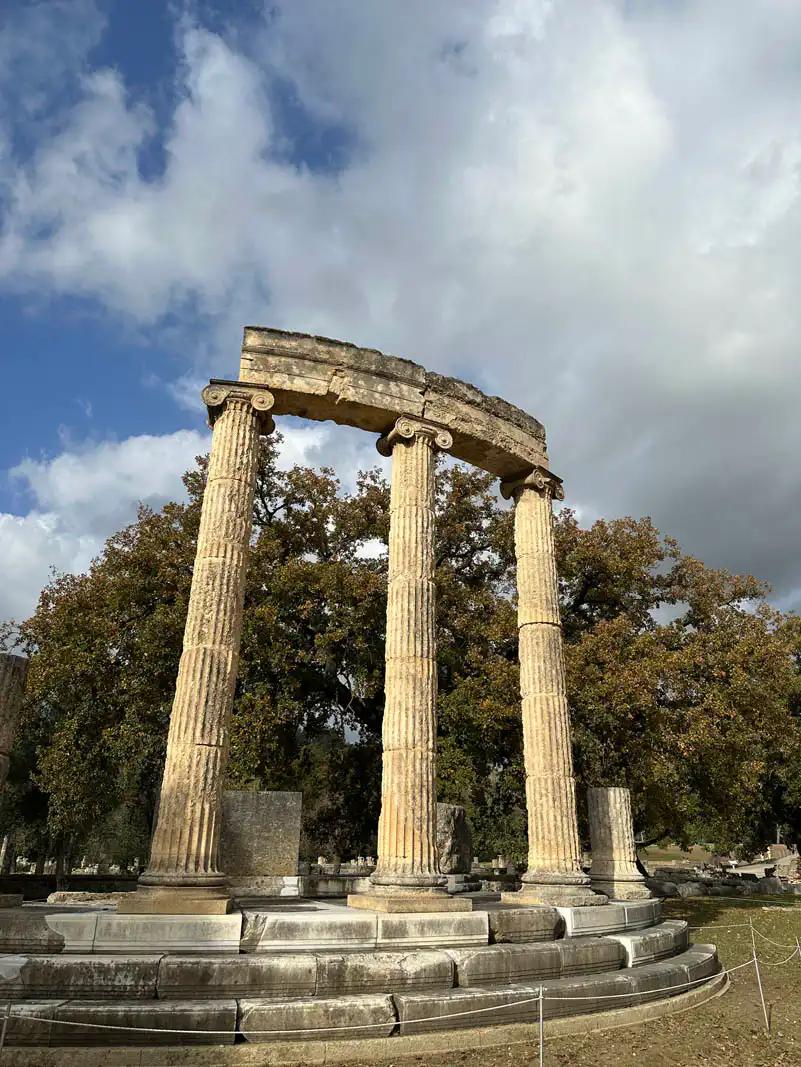
For nearly a thousand years, Delphi was the most important place in the Greek world. Not in military terms, not in political terms — though it shaped both — but in terms of meaning. City-states paused wars to consult it. Emperors sought its approval. Kings from Asia Minor sent their treasuries to honour it. The ancient Greeks believed, and placed into law, that Delphi was the centre of the earth — the point where Zeus released two eagles from opposite ends of the world and they met, directly above this sanctuary, on the southern slopes of Mount Parnassus.
Most visitors arrive at Delphi and see ruins on a hillside. Beautiful ruins, dramatically positioned, with a museum of considerable quality nearby. And they leave having missed the most interesting thing about the place — what it actually was, how it actually worked, and why the ancient world organised so much of itself around it.
Elena Gaitani is a licensed guide. She can explain all of it.
Why Delphi Is Misunderstood — And Why That Matters
The Oracle at Delphi is one of those institutions that modern people instinctively reduce to superstition. A priestess inhales volcanic gases. She produces incoherent utterances. Priests translate these into ambiguous prophecies. Credulous kings act on them and usually regret it. The whole affair, seen through a modern lens, is a cautionary tale about ancient irrationality.
This reading is almost entirely wrong — and understanding why changes everything about how you experience the site.
The sanctuary at Delphi was, for the better part of a millennium, the most sophisticated political intelligence network in the ancient Mediterranean. Delegations arrived from every corner of the Greek world and beyond, each carrying information about their home state, their military situation, their political ambitions, their economic resources. The priests — educated, observant, and operating within a network of informants that spanned the known world — processed this information continuously. The responses the Oracle delivered were not random. They were calibrated, often deliberately ambiguous, and consistently reflective of a deep institutional understanding of the political situation the petitioner was navigating.
When Croesus of Lydia asked whether he should attack Persia and received the answer that if he crossed the Halys river he would destroy a great empire, the ambiguity was not accidental. It was the considered assessment of an institution that understood both parties and chose not to commit.
Standing at Delphi without this context is like standing in a room where something very important happened and being told only that the ceiling was high. The architecture is present. The significance is not.
Elena puts the significance back.
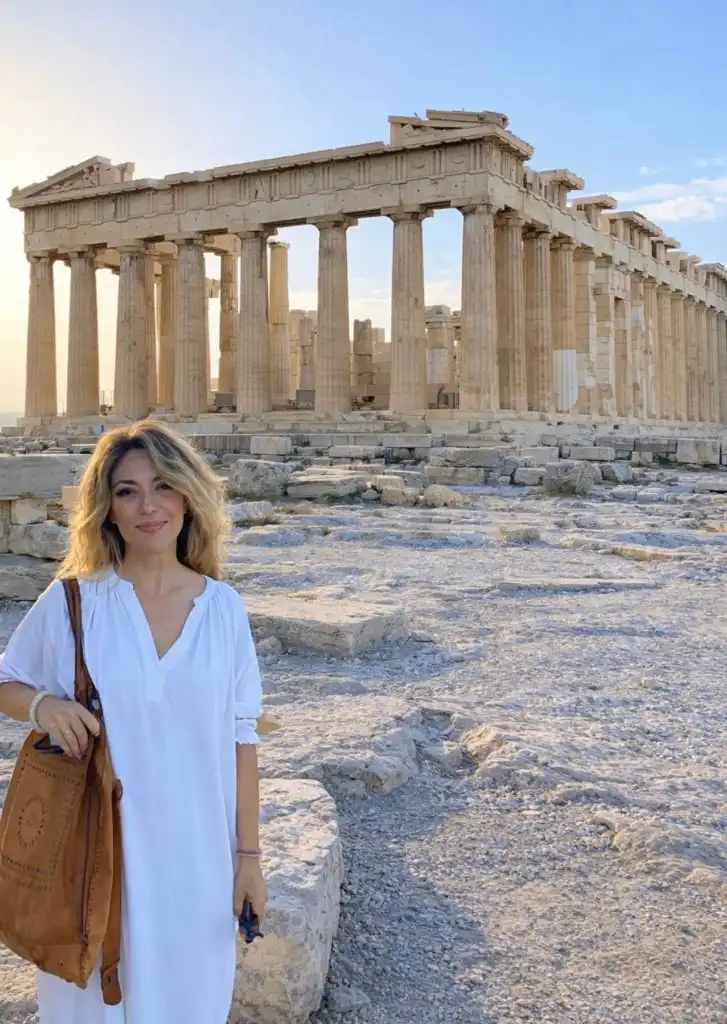
Elena Gaitani — Reading Delphi as a Licensed Guide
Elena is a licensed tour guide issued by the Greek Ministry of Tourism — the credential that authorises her to guide visitors inside the archaeological site and the Delphi Archaeological Museum.
Delphi occupies a specific place in her areas of expertise. The sanctuary spans a remarkable breadth of material: Mycenaean cult practice, Archaic votive offering, Classical civic architecture, Hellenistic sculpture, Roman intervention and renovation. To read the site coherently requires a scholar who can move between these periods without losing the thread of continuity — the institutional identity of the sanctuary that persisted across eight centuries of radical political change in the world around it.
She has guided private tours at Delphi across many seasons, in English, Italian, and French, for guests ranging from classical scholars who want a peer-level conversation to curious travellers encountering the ancient world for the first time. She calibrates every tour to the people in front of her.
What You Will Experience at Delphi
The drive from Athens to Delphi takes approximately at least three hours, passing through the mountains of Boeotia, rising through the olive groves of Amfissa — home to one of the most significant protected olive forests in Greece — and arriving at the sanctuary on the steep southern slopes of Parnassus, above the wide plain of the Pleistos valley.
The physical setting is as deliberate as everything else about Delphi. The Greeks did not place their most important sanctuary here by accident. The landscape performs a specific function: isolating the visitor from ordinary geography, from the flat coastal plains where cities were built and armies marched, and placing them somewhere that feels categorically different. The eagles still circle above the cliffs of the Phaedriades.
The Sacred Way
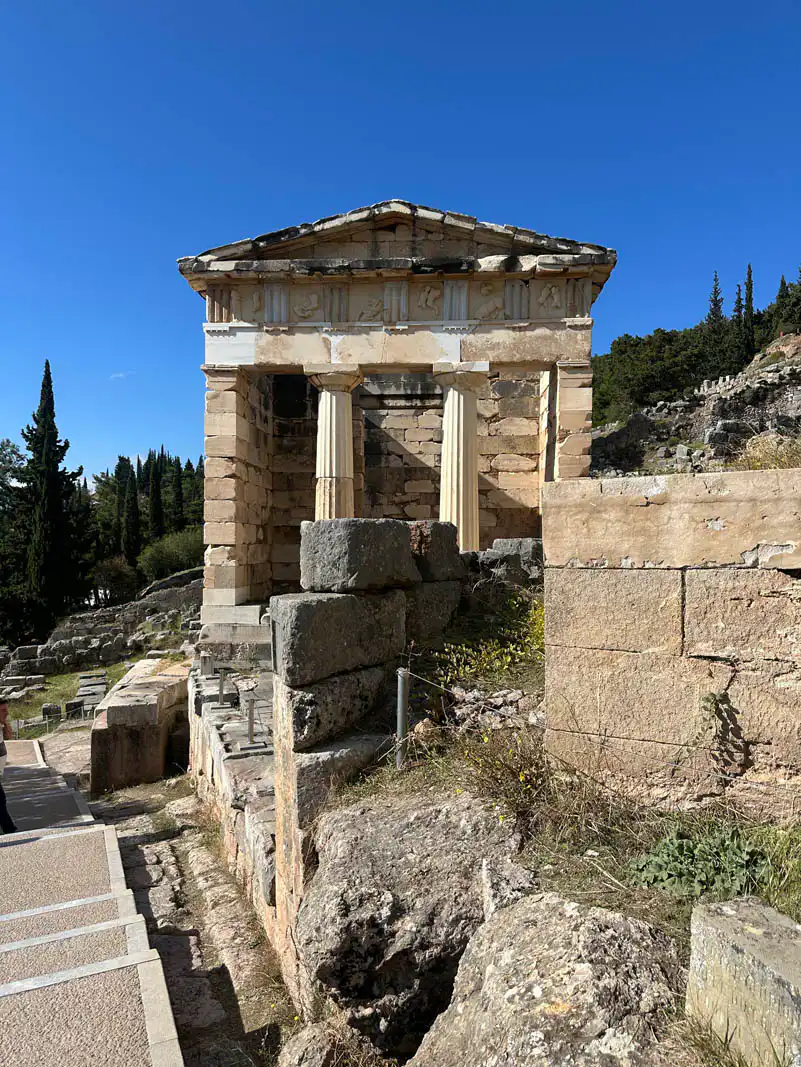
The processional route into the sanctuary — the Sacred Way — was lined on both sides with treasuries built by the city-states of Greece. Each treasury was a small temple-shaped building housing the votive offerings of its polis: the spoils of battles won, the dedications of victories achieved, the gratitude of athletes who had competed in the Pythian Games and won. Elena identifies the major treasuries — the Athenian Treasury, the Siphnian Treasury whose sculptural decoration was among the most ambitious of the Archaic period — and explains the competitive logic of their placement and design. Every treasury was also a political statement, read by every delegation that processed toward the Temple of Apollo above.
The Temple of Apollo
Six columns of the fourth-century Temple of Apollo still stand on the terrace above the Sacred Way, giving sufficient architectural evidence to reconstruct the building’s original presence. This is where the Oracle operated — the inner sanctuary, the adyton, where the Pythia delivered her responses in the presence of the petitioner and the attending priests. Elena reconstructs the consultation ritual in detail: who could consult, how they prepared, how the response was delivered, and how the institution maintained its authority across centuries.
The inscriptions carved into the temple’s pronaos — Know Thyself. Nothing in Excess. — are among the most discussed phrases in the history of Western thought. Elena explains what they meant to the ancient Greeks approaching the Oracle: not as general life advice, but as specific instructions to the petitioner about the correct frame of mind for an honest consultation.
The Theatre and the Stadium
Above the temple, cut into the slope of Parnassus, the ancient theatre commands a view of the entire sanctuary and, below it, the valley of the Pleistos and the silver-grey expanse of the olive groves stretching to the Gulf of Corinth. The theatre was used for the musical competitions of the Pythian Games — the second most prestigious pan-Hellenic games after Olympia. Elena describes what a performance here looked and sounded like, and what it meant for an artist to compete at Delphi.
Higher still, the ancient stadium — where the athletic competitions of the Pythian Games were held — is one of the best-preserved ancient stadiums in Greece , its stone seating largely intact. The view from the upper seating tier, with the mountain above and the sanctuary below, is one of the finest at any ancient Greek site.
The Delphi Archaeological Museum
The museum houses one of the most significant collections of Archaic and Classical Greek art in existence. Elena guides you through the major works with the depth they deserve.
The Charioteer of Delphi — a life-size bronze figure cast around 475 BC, originally part of a larger composition including a chariot and four horses — is one of the greatest works of classical Greek bronze sculpture to survive antiquity. Most visitors photograph it and move on. Elena explains the technical achievement of its casting, the specific qualities of the Early Classical style that make it a pivotal work in the development of Greek sculpture, and the extraordinarily well-preserved detail — the inlaid eyes of glass paste and stone, the fine modelling of the drapery, the barely perceptible turn of the head — that three years of fire and burial somehow preserved.
The Omphalos — a carved stone representing the navel of the world — and the treasury of the Siphnians, reconstructed from the metopes and frieze blocks displayed in the museum, complete a collection that rewards several hours of considered attention.
Frequently Asked Questions
Delphi Is at Least Three Hours from Athens. Understanding It Takes the Right Guide.
The ruins at Delphi will impress anyone. The sanctuary, the theatre, the Charioteer, the museum — these are extraordinary things to see. But Delphi was not built to be seen. It was built to be consulted, to be feared, to be honoured, and to be understood as the axis around which the ancient Greek world organised its most consequential decisions.
That understanding does not arrive on its own. It arrives with a licensed guide standing beside you.