
Ancient Messene: The City Built to Defy Sparta
Thucydides made a prediction about Sparta. If the city were ever deserted, he wrote, and only its foundations remained, future generations would find it very hard to believe that its power had matched its reputation. Sparta built no great temples. It left almost nothing behind.
Thirty-five kilometres to the west, on the slopes of Mount Ithome, stands the city that Sparta’s enemies built to contain it. Ancient Messene was founded in a single act of political engineering in 369 BC, walled with nine kilometres of fortification, given a stadium, a theatre, a sanctuary, an assembly hall and a marketplace — and populated with the descendants of people the Spartans had held in bondage for three hundred years.
Sparta is a modern town with a museum. Messene is a city you can walk through. The visitors go to Sparta.
Three Hundred Years of Helotage
To understand Messene, begin with what preceded it.
Messenia is the most fertile region of the Peloponnese: broad plains, reliable water, olives and grain. In the eighth century BC, Sparta — a landlocked neighbour across the Taygetos mountains — invaded and took it. The ancient sources describe two long conflicts, conventionally called the First and Second Messenian Wars, fought across the late eighth and seventh centuries BC.
The consequence was not conquest in the ordinary sense. The Messenians were not absorbed, expelled or enslaved individually. They were reduced collectively to the status of helots: a subject agricultural population, bound to the land, working the estates that supported the Spartan citizen body. Sparta’s entire social system — the barracks upbringing, the lifelong military training, the famous austerity — was possible because Messenian labour fed it, and necessary because that labour had to be controlled.
This lasted, in one form or another, for roughly three centuries. Pausanias, writing in the second century AD, devotes the fourth book of his description of Greece to the Messenians and preserves the memory of their resistance — the hero Aristomenes above all, whose exploits in the Second War were still being recited a thousand years after the events they describe.
The Messenians did not forget who they were. That fact is the reason the city exists.
369 BC — a City as a Weapon
In 371 BC, at Leuctra in Boeotia, the Theban general Epaminondas destroyed the Spartan army in a single afternoon. The myth of Spartan invincibility ended on that field.
What Epaminondas did next was more consequential than the battle. He marched into the Peloponnese and, in 369 BC, founded a city at the foot of Mount Ithome — the mountain that had been the centre of Messenian resistance in every previous revolt. He recalled the Messenian exiles from Sicily, from North Africa, from wherever the diaspora had settled them. He walled the new city on a scale that no siege of the period could reduce.
Sparta’s economy depended on Messenian helots. Messene liberated them and gave them a fortress. Spartan power did not recover.
The city was, in other words, a strategic instrument disguised as an act of liberation — and it was also, genuinely, an act of liberation. Both descriptions are true, and the site records both.
What You Actually Walk Through
Ancient Messene is not a scatter of foundations. It is an urban plan, excavated since 1986 under the direction of the archaeologist Petros Themelis, and the coherence of what has emerged is the reason specialists rate it among the most important excavations in Greece.
The walls. Roughly nine kilometres of circuit, following the ridgelines, with towers at intervals. The Arcadian Gate on the northern side is the piece to see: a circular courtyard between an outer and an inner gateway, designed so that attackers who breached the first door found themselves enclosed and exposed on all sides. The monolithic lintel is still in place. The ruts of ancient cart wheels are still cut into the paving of the road that runs through it.
The Asklepieion. Not a healing sanctuary in the manner of Epidaurus, but the civic and religious heart of the city — a colonnaded square with a temple at its centre, surrounded by council chambers, an archive, a small theatre used for assemblies, and rooms whose statue bases still carry the names of the people they honoured.
The stadium and gymnasium. This is where visitors stop talking. A long running track enclosed on three sides by Doric colonnades, with the mountain behind it and the plain below, and at the far end a monumental tomb — a heroon, built for the city’s benefactors, standing directly on the stadium’s axis. It is one of the most complete athletic complexes to survive from the Greek world, and on most days you will have it to yourself.
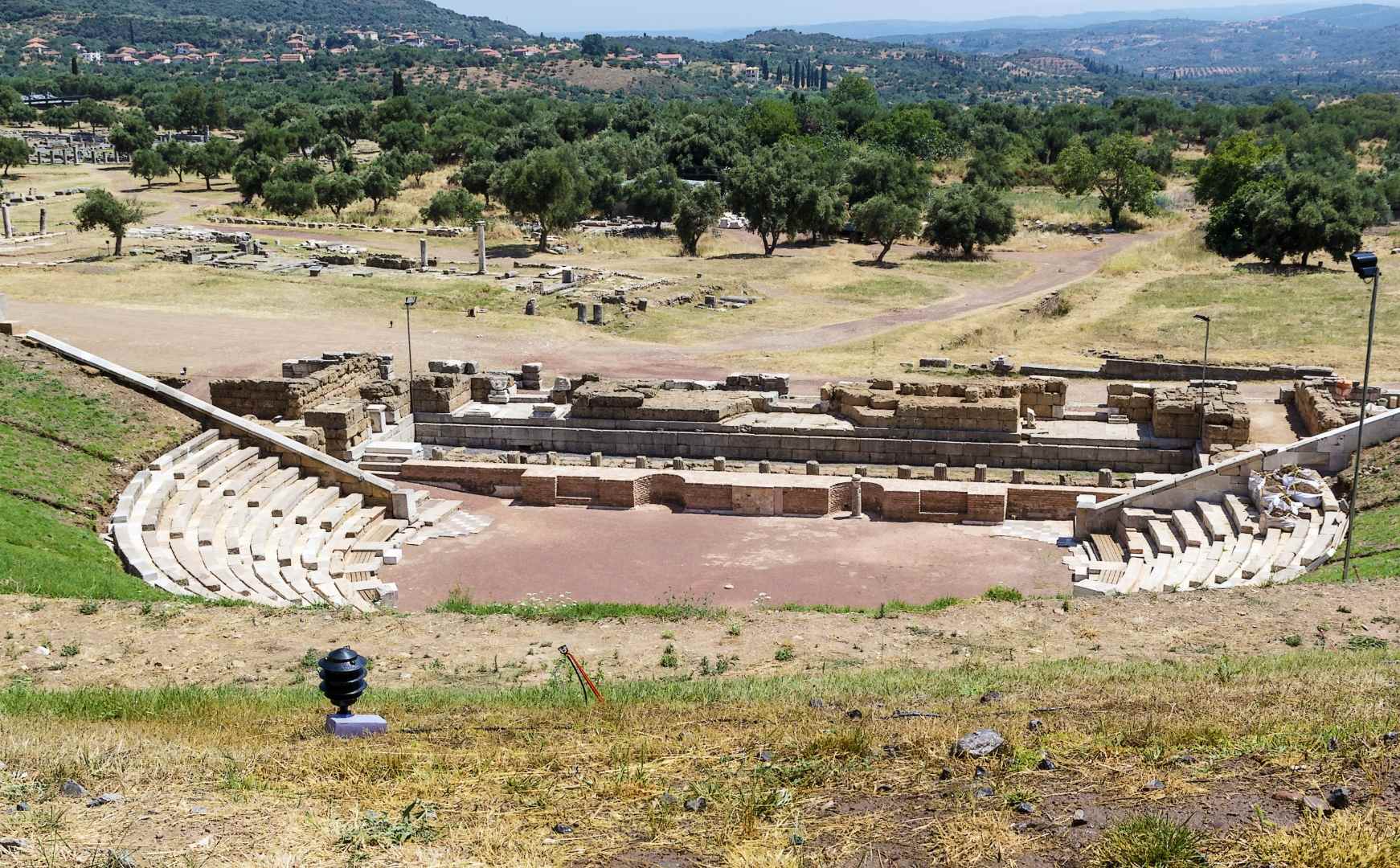
The theatre, whose retaining walls and vaulted entrance passages have been substantially restored, and which hosted, in antiquity, assemblies as often as performances.
The fountain of Arsinoe, in the agora, still fed by the spring that determined where the city was placed.
Why the Site Is Empty
Messene receives a fraction of the visitors who go to Olympia, ninety minutes north, or Mycenae, two hours east. The reason is not quality. It is narrative.
Olympia has the Games. Mycenae has Agamemnon and Homer. Epidaurus has the acoustics. Messene has a story that requires two paragraphs of Peloponnesian political history before it becomes legible, and mass tourism does not stop for two paragraphs.
The result is a major classical city — walls, stadium, theatre, agora, sanctuary, all of it excavated and much of it standing — where a visitor on a weekday morning in spring may encounter a handful of other people. Whatever else it is, it is the closest thing in Greece to the experience of finding an ancient site rather than queuing for one.
The neighbouring village of Mavromati sits above the ruins, on the mountainside, with the spring running through it. Kalamata is thirty kilometres away, half an hour by road.
Messene and Sparta on the Same Day
The two sites belong together, and the order matters.
See Messene first, in the morning, when the light comes across the plain and the stadium colonnades throw long shadows. Then drive east over the Taygetos range — a spectacular road in itself — to Sparta in the afternoon.
What you find there is instructive. Modern Sparta is a nineteenth-century grid town. The ancient city has left an acropolis with a theatre cut into it, the sanctuary of Artemis Orthia where Spartan boys were ritually flogged, the Menelaion on a ridge outside town, and an archaeological museum. Thucydides was right: the foundations do not suggest the power.
The lesson lands only when the two are seen in sequence. The city that built nothing dominated Greece for three centuries. The city that built everything was constructed to end it. Twenty kilometres of mountain separate them, and the Byzantine city of Mystras — a UNESCO World Heritage site of extraordinary preservation — stands on the slope above Sparta, a thousand years later, as a third act.
Frequently Asked Questions
What is Ancient Messene famous for?
Ancient Messene was founded in 369 BC by the Theban general Epaminondas, immediately after his defeat of Sparta at Leuctra, in order to free the Messenians from three centuries of Spartan helotage and to permanently weaken Sparta by removing the agricultural population that sustained it. The site preserves an almost complete Greek city: a nine-kilometre fortification circuit, the Arcadian Gate, a stadium enclosed by Doric colonnades, a theatre, an agora and the Asklepieion civic complex.
Where is Ancient Messene and how do I get there?
The site lies beside the village of Mavromati in Messenia, in the southwestern Peloponnese, at the foot of Mount Ithome. It is roughly thirty kilometres from Kalamata — about half an hour by road — and around two and a half hours from Nafplio. Ancient Messene should not be confused with the modern town of Messini, which is nearby but is not the archaeological site.
Who were the Messenian Wars fought between?
Between Sparta and the Messenians, across the late eighth and seventh centuries BC. Sparta’s victory reduced the Messenian population to helot status — a subject agricultural class bound to the land — and this arrangement underwrote the Spartan military system until Messene was founded in 369 BC. The ancient account survives principally in the fourth book of Pausanias, who preserves the resistance traditions surrounding the hero Aristomenes.
Is Ancient Messene worth visiting compared with Olympia or Mycenae?
They offer different things. Olympia and Mycenae are famous sanctuaries and citadels with celebrated museums and considerable crowds. Messene is an entire excavated city — walls, gate, stadium, theatre, agora — that most visitors never reach, and it is possible to walk it in near solitude. Travellers who have already seen the standard Peloponnesian circuit frequently describe Messene as the site that surprised them.
Can Ancient Messene and Sparta be visited in one day?
Yes. The two are separated by roughly seventy kilometres of mountain road over the Taygetos range. Messene rewards a morning; Sparta and its museum occupy an afternoon; the Byzantine city of Mystras on the slope above Sparta can be added with an early start or reserved for the following day. A licensed guide, authorized by the Greek Ministry of Tourism, may accompany visitors inside all three.
Messene was constructed as an argument — that a people held in bondage for three hundred years could return, build in stone, and outlast the power that had held them. The argument is legible on the site, in the walls and the stadium and the names carved on the statue bases, and it is almost entirely invisible to a visitor without the history.
Elena Gaitani is a licensed private guide, authorized by the Greek Ministry of Tourism, with a particular connection to Messenia. She guides Ancient Messene, Sparta and Mystras for travellers who want the reasons behind the ruins.