
Why Your Guide’s License Is the Most Important Decision You’ll Make in Greece
The Difference Between Seeing Ancient Greece and Understanding It
Somewhere in the planning of every trip to Greece, travelers spend time choosing their hotel, their ferry route, their island sequence. They compare views and amenities and proximity to the water. These are meaningful choices.
And then, at the site they traveled thousands of miles to reach — the Acropolis, Ancient Olympia, Delphi — they hand themselves over to whoever happens to be standing at the gate with a sign.
The guide is the most consequential variable in any Greek cultural experience. More than the time of day, more than the crowd level, more than the quality of the photographs — who explains what you are looking at determines what you take home with you. And in Greece, not every person calling themselves a guide is legally permitted to stand inside the monuments and do that explaining.
This is not a minor technicality. It is the difference between two entirely different experiences.
What Greek Law Actually Says About Tour Guides
Greece maintains one of the most rigorous tour guide licensing systems in Europe. The credential — issued by the Greek Ministry of Culture — requires candidates to hold a university degree in archaeology, art history, or a related discipline, complete a full professional diploma at the Tour Guide School of Athens, and pass a national examination covering the history, archaeology, and geography of Greece in its entirety.
Holders of this license are the only professionals legally authorized to:
Enter and guide inside state archaeological sites — including the Acropolis, Delphi, Olympia, Epidaurus, Mycenae, and all other Ministry-controlled monuments.
Lead tours inside state museums — including the National Archaeological Museum, the Acropolis Museum, the Archaeological Museum of Olympia, and all regional museums.
Interpret the sites professionally — explaining the architectural, historical, and artistic significance of what visitors are seeing, as authorized by the Greek state.
Anyone operating outside this license — regardless of how experienced, how knowledgeable, or how widely recommended — must remain outside these spaces. Their clients enter the monument. They do not.
This is not a grey area. It is Greek law, and it is enforced.
The “Driver-Guide” Problem — And Why It Matters to You
The market for tours and transfers in Greece is large, and much of it operates in a category that can be described as “driver-guides” — individuals who provide private transportation and accompany clients to archaeological sites, often with genuine knowledge and enthusiasm, but without the Ministry license.
They are not fraudulent. They are simply operating in a different category from what their clients often assume.
The problem arises at the entrance to the monument.
A licensed guide enters with you. They walk through the Propylaea and across the Acropolis plateau and stand beside you at the Parthenon, answering questions in real time, adjusting the narrative to your responses, pointing to the specific architectural detail that changes everything you thought you understood.
A driver parks and waits.
You may not know this until you arrive at the gate. By then the decision has already been made.
For travelers who visit Greece primarily for its ancient history — who have read about these sites, who understand what they are approaching, who have allocated significant time and money to the experience — this is not a distinction they would have chosen to ignore if it had been clearly explained to them.
Elena Gaitani — What Her Credentials Actually Mean
Elena holds a Bachelor’s degree in Archaeology and Art History from the University of Athens — one of the foremost programs for classical archaeology in the Greek-speaking world. She completed her professional diploma at the Tour Guide School of Athens and holds the full national license issued by the Ministry of Culture, valid throughout Greece.
She has guided private tours for years across Athens, the Peloponnese, Delphi, and Meteora. Over that time, she has developed a particular expertise in the way people with genuine intellectual curiosity engage with ancient material — the questions they ask, the connections they want to make, the moments when a piece of information reorganizes everything they thought they already knew.
Her approach is not a recitation. It is a conversation calibrated to the person standing beside her.
She speaks English, Italian, and French at a professional level. She adapts the depth and register of every tour to her guests — whether they are specialists who want to discuss historiography, or first-time visitors who simply want to understand why the Parthenon is considered one of the greatest architectural achievements in human history and to feel, briefly, the weight of standing inside it.
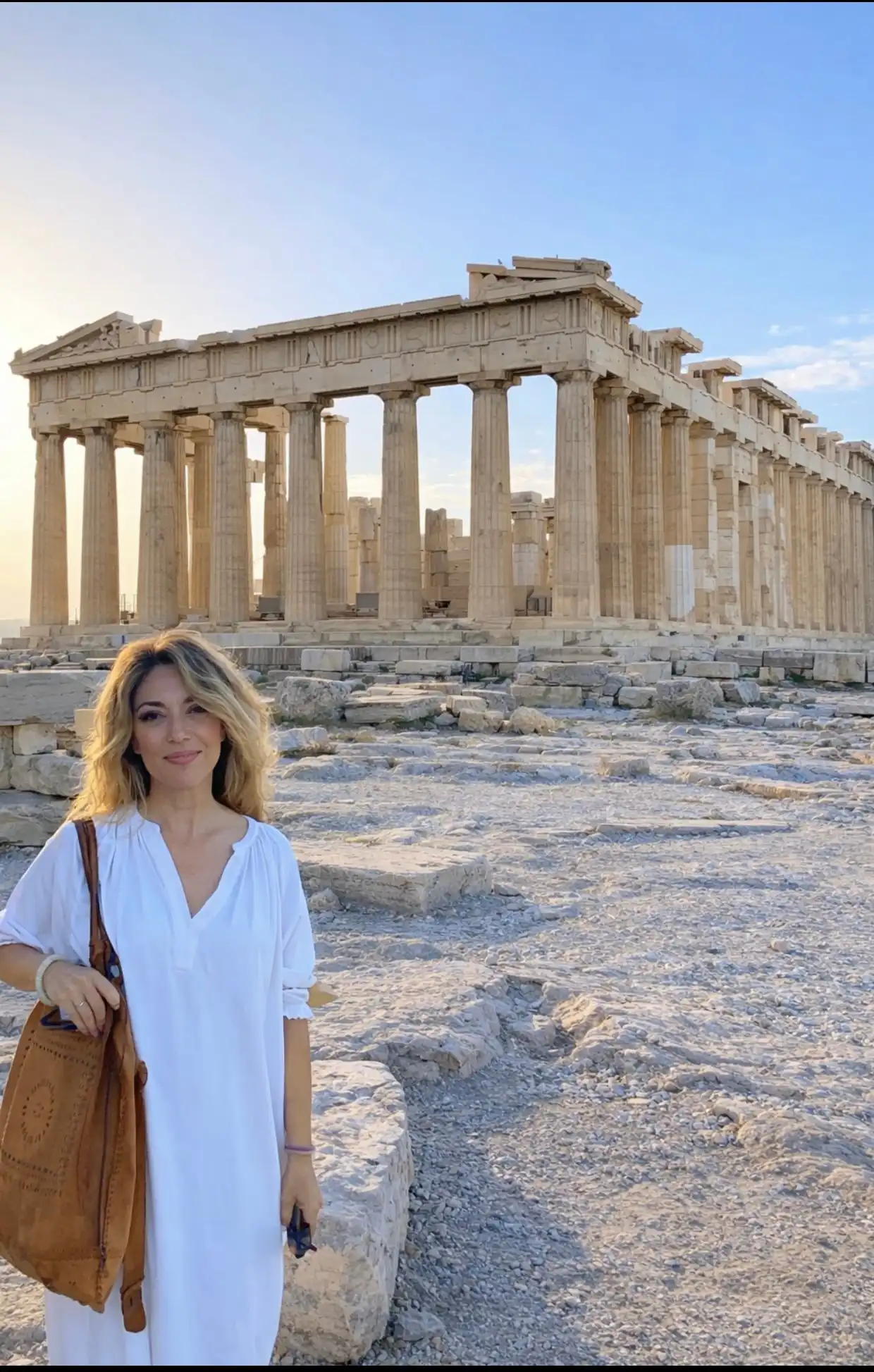
What Changes When Your Guide Is an Archaeologist
The practical difference between a licensed archaeologist-guide and an unlicensed driver is access. The experiential difference is everything else.
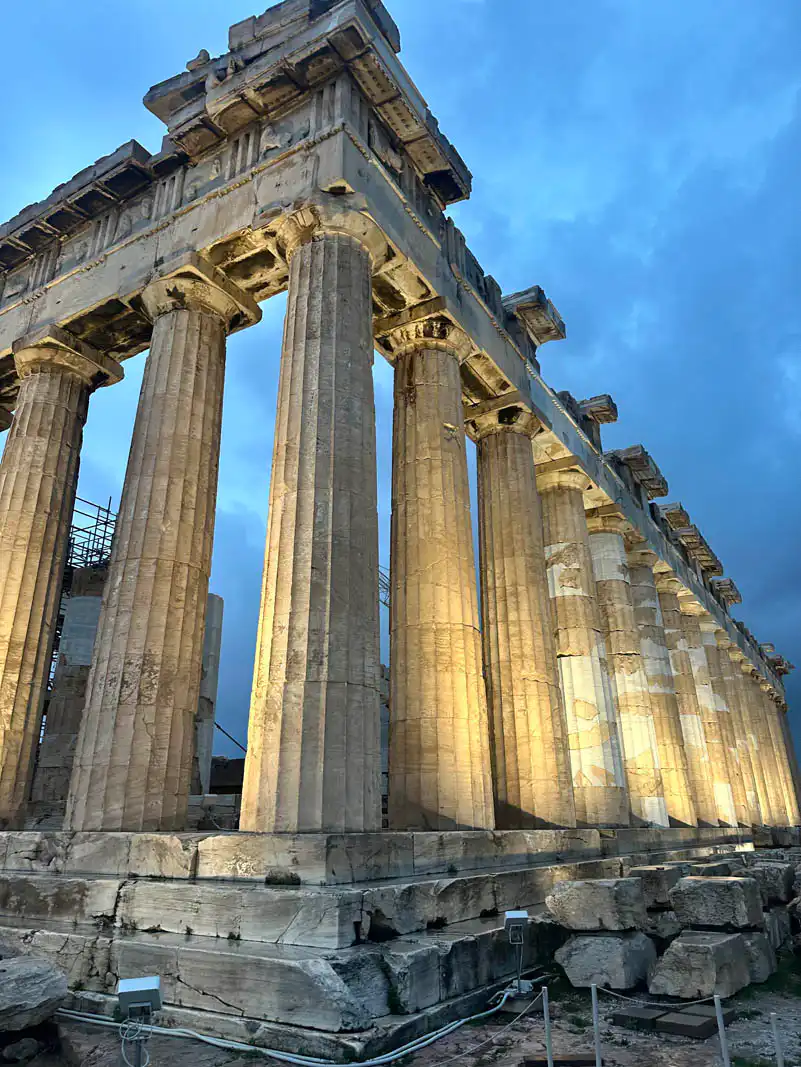
An archaeologist reads a site differently from a layperson — and differently from a generalist guide. They have spent years studying primary sources, comparative material, and the archaeological record that underlies what is visible on the surface. When Elena looks at the Parthenon’s east pediment, she is not seeing a famous sculpture. She is seeing a specific compositional solution to the theological problem of representing the birth of a goddess — and she can explain why the sculptor made each decision in terms that connect Greek religion, civic politics, and the formal development of classical art.
At the Acropolis:
The entasis of the Doric columns — that barely perceptible outward curvature along the shaft — is typically described as an optical correction. Elena explains the specific perceptual problem it solves, the engineering precision required to execute it without modern instruments, and the broader design philosophy that produced a building that reads as geometrically perfect from every approach angle despite containing no straight lines.
At Olympia:
The chryselephantine statue of Zeus — one of the Seven Wonders of the Ancient World, now lost — can be partially reconstructed from ancient descriptions, coin imagery, and the surviving remains of the workshop in which it was created. Elena makes that reconstruction vivid and specific, so that the empty cella of the Temple of Zeus becomes a space charged with what was once inside it.
At Delphi:
The oracle — the most influential political and religious institution in the ancient Greek world for nearly a thousand years — is often treated as a curiosity or a superstition. Elena explains the sophisticated institutional structure behind it: the consultation process, the political intelligence embedded in the ambiguous responses, the way the sanctuary managed to remain authoritative across centuries of radical political change.
In each case, the difference is not simply more information. It is a different quality of understanding — the kind that stays with you.
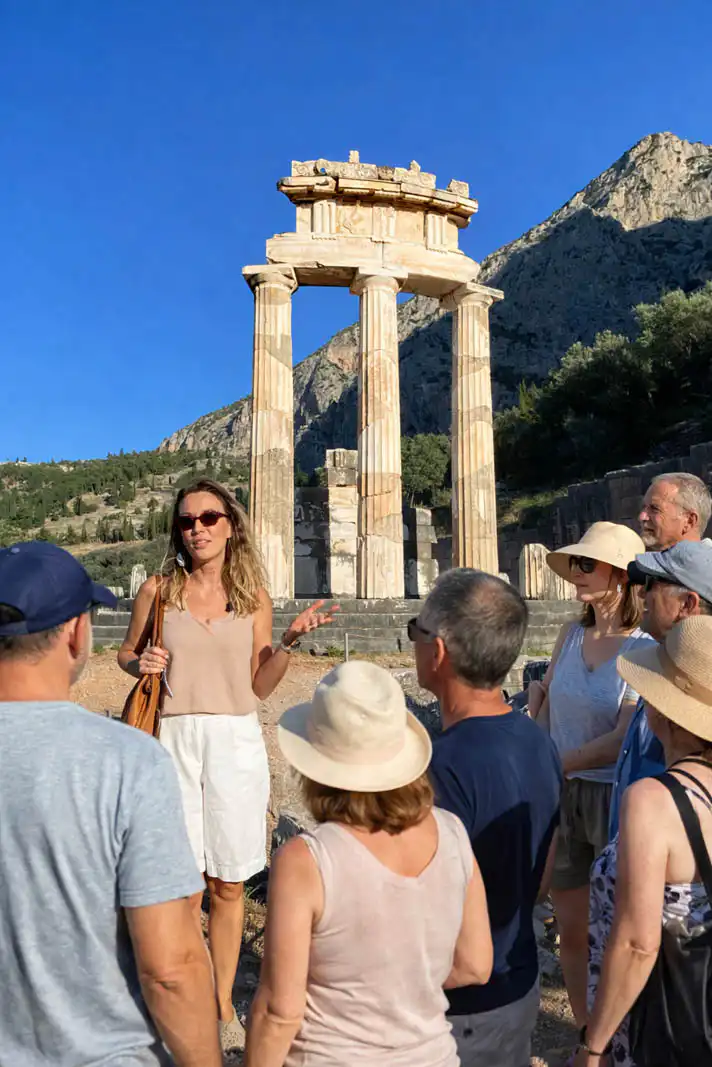
The Tours Elena Offers
Elena offers private, bespoke tours across Greece. Every itinerary is designed around the interests, pace, and schedule of the individuals she is guiding.
Athens and the Acropolis — Full-day or half-day private tours of the Acropolis, the Acropolis Museum, the National Archaeological Museum, and the historic neighborhoods of the city.
Shore Excursions — Private excursions for cruise passengers arriving at Piraeus (for Athens) and Katakolon (for Ancient Olympia), with guaranteed return to the ship.
Peloponnese — Multi-day private tours through Olympia, Mycenae, Epidaurus, Nafplio, Ancient Messene, Kalamata, the Mani, and Monemvasia.
Delphi and Central Greece — Private day tours to the sanctuary of Apollo at Delphi, with optional extensions to Arachova and the monastery of Hosios Loukas.
Meteora — Private tours of the rock monasteries of Meteora with full archaeological and Byzantine historical context.
All tours are conducted in English, Italian, or French. All tours are strictly private.
Frequently Asked Questions
The Right Guide Makes Greece Unforgettable.
If you are planning a trip to Greece and the ancient history is what brought you here — if the Parthenon, the Olympic Stadium, the sanctuary at Delphi are not background scenery but the reason for the journey — then the guide you choose is the most important decision you will make.
Elena Gaitani is licensed, fluent, and deeply expert. She will be beside you, inside the monument, from the moment you arrive to the moment you leave.